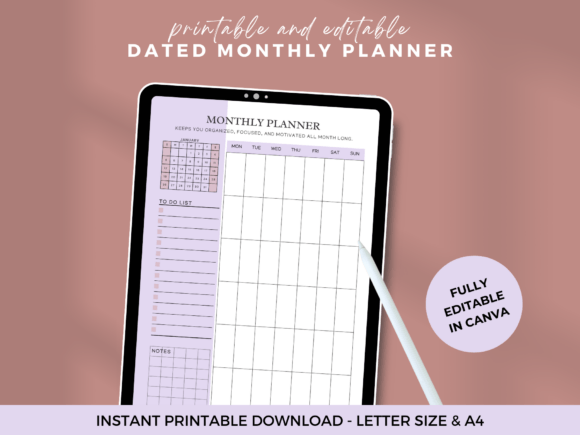
Mastering Time: The Comprehensive Guide to Using a Dated Monthly Planner
In an era dominated by digital notifications, calendar apps, and AI-driven scheduling tools, the enduring popularity of the dated monthly planner might seem counterintuitive. Yet, for students, professionals, creatives, and busy parents alike, this analog tool remains a cornerstone of effective time management. A dated monthly planner is more than just a booklet with pre-printed dates; it is a cognitive framework that transforms abstract time into a tangible, manageable landscape. Understanding how to leverage this tool effectively can bridge the gap between overwhelming busyness and intentional productivity.
Defining the Dated Monthly Planner
At its most fundamental level, a dated monthly planner is a physical or digital organizational system where specific dates are pre-assigned to pages or spreads for a defined period, typically twelve months. Unlike undated planners, which offer flexibility but require setup time, dated planners provide immediate structure. They serve as an external hard drive for your brain, offloading the mental energy required to remember appointments, deadlines, and goals.
The significance of this tool lies in its visual representation of time. When you look at a monthly spread, you are not seeing a list of tasks; you are seeing the finite nature of your resources. This visual constraint forces prioritization in a way that infinite-scrolling digital lists often fail to do. Whether used for business forecasting, academic semester planning, or personal habit tracking, the dated monthly planner acts as a central command center for daily life.
The Cognitive Benefits of Analog Planning
While technology offers convenience, research suggests that writing by hand enhances memory retention and conceptual understanding. This phenomenon, known as the generation effect, implies that the physical act of recording information in a dated monthly planner creates stronger neural pathways than typing the same data into an app.
Enhanced Focus and Reduced Distraction
Digital devices are inherently multi-purpose environments designed to capture attention. Opening a calendar app on a smartphone often leads to unintended browsing. A physical dated monthly planner is a single-task device. It offers a sanctuary of focus where planning occurs without the interference of pop-up ads, emails, or social media notifications. This dedicated environment encourages deeper thinking about priorities rather than reactive scheduling.
Spatial Memory and Visual Processing
Humans possess strong spatial memory. We tend to remember where information was located on a page better than the information itself. A dated monthly planner leverages this by providing consistent spatial landmarks. You might recall that a dentist appointment was written in the "top right corner of the second week" long before you remember the exact date. This spatial anchoring makes retrieval faster and reduces cognitive load during busy days.
Practical Applications Across Different Domains
The versatility of a dated monthly planner allows it to adapt to various contexts. Understanding these applications helps users select the right format and utilize it more effectively.
- Academic Success: For students, a dated monthly planner aligned with the school year is essential for visualizing exam cycles, assignment deadlines, and break periods. It prevents the "surprise deadline" syndrome by mapping out the entire semester at a glance.
- Business and Professional Work: Professionals use monthly spreads for high-level project management. While daily tasks belong in a to-do list, the monthly view tracks milestones, client meetings, and quarterly reviews. It serves as a strategic overview that keeps daily tactics aligned with long-term objectives.
- Creative Projects: Creatives often struggle with unstructured time. A dated planner provides necessary guardrails without stifling inspiration. Writers, artists, and musicians use it to schedule creative blocks, track submission deadlines, and balance administrative work with artistic practice.
- Personal Wellness and Home Management: Beyond work, these planners track medical appointments, fitness routines, meal prep schedules, and family events. Integrating personal wellness into the same system as professional obligations ensures a holistic view of work-life balance.
Choosing the Right Format for Your Needs
Not all dated monthly planners are created equal. Selecting the appropriate layout is crucial for sustained usage. The market generally offers three primary configurations, each serving different cognitive styles.
- Traditional Monthly Grid: The classic calendar view with boxes for each day. Best for users who need to see multiple appointments simultaneously and value spatial arrangement over detailed note-taking.
- Vertical Column Layout: Days are listed vertically with ample space for hourly breakdowns or task lists. Ideal for those who have many daily commitments and need to integrate time-blocking directly into their monthly view.
- Horizontal or List View: Resembles a lined notebook with dates printed in margins. Perfect for journalers and narrative planners who prefer writing sentences over bullet points and need maximum writing space.
Additionally, consider the start date. Academic planners typically run from July to June, while standard planners run January to December. Choosing a cycle that matches your natural rhythm prevents the frustration of unused pages or mid-year transitions.
Common Misunderstandings About Dated Planners
Despite their utility, several misconceptions prevent people from fully benefiting from dated monthly planners. Addressing these assumptions is key to building a sustainable planning practice.
The Perfectionism Trap
A prevalent myth is that a planner must be aesthetically perfect or filled out consistently to be useful. Social media has popularized elaborate "plan-with-me" videos featuring calligraphy and stickers. However, functionality always supersedes form. A messy planner with accurate information is infinitely more valuable than a pristine one that fails to reflect reality. Missed days should be ignored, not mourned. The planner is a tool, not a test of discipline.
Rigidity vs. Structure
Some critics argue that pre-dated formats are too rigid because they cannot accommodate unpredictable schedules. In reality, structure enables flexibility. By having a clear baseline of committed time, you can more easily identify open slots for spontaneous opportunities or necessary rest. The dates provide a container; how you fill that container remains entirely within your control.
Digital Replacement Fallacy
Another assumption is that digital calendars have rendered paper planners obsolete. While digital tools excel at reminders and sharing, they lack the tactile engagement that reinforces commitment. Many highly productive individuals adopt a hybrid approach: using digital calendars for logistics and alerts, and a dated monthly planner for strategy, reflection, and intentional design of their time.
Integrating Technology with Traditional Planning
Modern life rarely exists solely in analog or digital spheres. The most effective users of dated monthly planners understand how to integrate them with technological ecosystems. This synergy combines the best attributes of both worlds.
Consider using your digital calendar as a capture tool for incoming requests and automated reminders, then transferring confirmed commitments to your physical planner during a weekly review session. This transfer process acts as a filter, forcing you to evaluate whether an event truly deserves your time before committing ink to paper. Furthermore, digital tools can support the physical planner through photo backups of important spreads or voice-to-text notes that are later transcribed into the monthly layout.
Building a Sustainable Planning Habit
Owning a dated monthly planner does not automatically confer organizational skills. Like any instrument, it requires practice. Beginners should start simple, focusing only on recording fixed commitments and top-three priorities. As confidence grows, additional layers such as habit trackers, gratitude logs, or project timelines can be introduced.
Consistency is built through ritual. Establishing a specific time and place for planning—such as Sunday evening with coffee or Friday afternoon before closing the laptop—conditions the brain to enter a planning mindset. Over time, interacting with the dated monthly planner becomes less of a chore and more of a grounding practice that clarifies intentions and reduces anxiety.
Ultimately, the dated monthly planner is a mirror reflecting how we choose to spend our most non-renewable resource. By understanding its purpose, respecting its cognitive benefits, and adapting it to modern complexities, anyone can transform this simple book of dates into a powerful engine for a more organized, intentional, and fulfilling life. Whether you are managing a corporation, navigating university, or simply trying to remember soccer practice, the right planner, used with understanding, makes the difference between surviving time and mastering it.