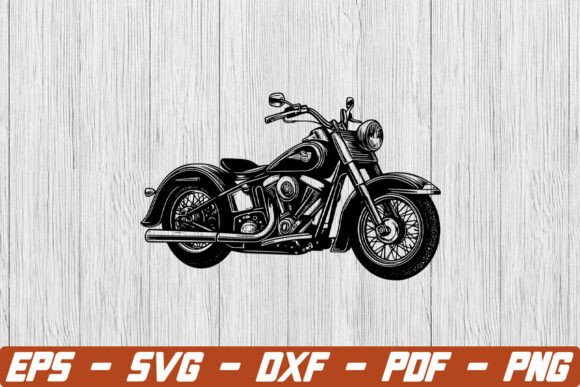
Evaluating Vintage Motorcycle Silhouette Vector SVG Assets for Professional Design
In the landscape of digital asset creation, few niches demand as much precision and stylistic awareness as automotive nostalgia. A Vintage Motorcycle Silhouette Vector SVG is more than a simple clip-art graphic; it is a foundational design element that bridges historical accuracy with modern scalability. For professionals ranging from apparel designers to marketing agencies, understanding the technical and aesthetic nuances of these assets is critical. The value lies not merely in the image itself, but in its utility across diverse media, its adherence to specific era-correct styling, and its technical construction within vector editing software.
Defining Technical Quality and Structural Integrity
When evaluating a Vintage Motorcycle Silhouette Vector SVG, the primary metric must be path integrity. Unlike raster images, vectors are mathematical constructs. A high-quality silhouette should exhibit clean anchor points, minimal node counts, and smooth Bézier curves. Excessive nodes often indicate an auto-trace conversion from a low-resolution JPEG rather than a hand-drawn or professionally digitized vector. Auto-traced files frequently contain jagged edges, stray points, and open paths that cause failures during CNC routing, laser cutting, or vinyl plotting.
Professional-grade assets distinguish themselves through intentional simplification. A silhouette relies on negative space and outer contours to convey form. If a vector file includes excessive internal detail that muddies the profile when scaled down to one inch, it fails its primary function. Conversely, if key identifying features—such as the distinct curve of a 1940s fender or the exposed springer fork of a pre-war bike—are lost to over-simplification, the asset loses its historical resonance. The best files strike a balance where the motorcycle is instantly recognizable at both billboard scale and business card size without requiring manual cleanup.
File Format Compatibility and Workflow Integration
While SVG (Scalable Vector Graphics) is the web standard, professional workflows often require broader compatibility. A robust Vintage Motorcycle Silhouette Vector SVG package typically includes source files in AI, EPS, or PDF formats alongside the SVG. This ensures that users working in Adobe Illustrator, CorelDRAW, Affinity Designer, or specialized CAD software can edit the artwork without compatibility errors. For creators using Cricut Design Space or Silhouette Studio, the SVG must be properly layered and grouped. Ungrouped elements or compound paths that have not been welded correctly can result in disjointed cuts, wasting material and time. Evaluating an asset before purchase involves checking whether the creator understands these fabrication-specific requirements.
Historical Accuracy as a Value Proposition
The market is saturated with generic "biker" graphics that lack specificity. For serious hobbyists, educators, and niche marketers, generic is insufficient. A valuable Vintage Motorcycle Silhouette Vector SVG captures the distinct engineering characteristics of specific eras. There is a profound visual difference between a 1960s British café racer, a 1970s Japanese UJM (Universal Japanese Motorcycle), and a 1930s American V-twin. Using an inaccurate silhouette in a project targeting knowledgeable enthusiasts can undermine credibility immediately.
High-value assets are often categorized by make, model, or subculture. When sourcing these graphics, look for descriptions that reference specific mechanical attributes. Does the exhaust routing match the engine configuration? Is the headlight shape period-appropriate? These details matter because they signal respect for the subject matter. For publishers creating educational content or museum exhibits, this accuracy is non-negotiable. For apparel brands, it differentiates a premium heritage product from fast-fashion novelty wear. The most effective silhouettes serve as visual shorthand, communicating a specific time and place without needing accompanying text.
Audience Alignment and Niche Application
Different user groups derive value from these assets in distinct ways. Understanding your specific use case helps determine which type of Vintage Motorcycle Silhouette Vector SVG is necessary.
- Apparel and Merchandise Designers: Require bold, high-contrast shapes optimized for screen printing and DTG. Internal transparency and distressed texture overlays within the vector are often desirable to reduce ink coverage and enhance the vintage aesthetic.
- Laser and CNC Fabricators: Need single-color, fully welded paths with no overlapping lines. Stencil bridges must be integrated into the design to prevent islands from falling out during physical cutting.
- Web Developers and UI Designers: Prioritize lightweight file sizes and responsive scaling. Inline SVG code that can be manipulated via CSS for hover states or animations offers superior performance compared to embedded images.
- Content Creators and Bloggers: Benefit from versatile compositions that include multiple angles or customizable elements, allowing for consistent branding across thumbnails, headers, and social media cards.
Practical Performance in Real-World Projects
Theoretical quality differs from applied performance. In practice, a Vintage Motorcycle Silhouette Vector SVG must withstand the rigors of production. When applied to dark textiles, does the silhouette maintain legibility? When converted to a monochrome logo for embossing, do the proportions hold up? Experienced designers test assets in context before committing them to final deliverables.
One common friction point is color separation. Many "vintage" vectors come pre-colored with gradients or complex meshes that are difficult to modify. For maximum flexibility, seek out assets provided in solid spot colors or pure black-and-white line art. This allows the designer to apply their own color palettes, textures, and effects without fighting existing styling. A truly useful silhouette acts as a canvas, not a finished painting. It should integrate seamlessly into larger compositions, serving as a supporting graphical element rather than dominating the layout unless intended as a hero image.
Licensing, Commercial Viability, and Ethics
Beyond aesthetics and geometry, licensing dictates professional viability. A Vintage Motorcycle Silhouette Vector SVG may be visually perfect but legally unusable for commercial projects. Always verify whether the license covers merchandise resale, client work, or digital distribution. Some licenses restrict the number of units sold or require attribution, which may be impractical for certain business models.
Furthermore, intellectual property considerations extend to trademarked logos and branded elements. A silhouette of a motorcycle is generally safe, but including specific manufacturer badges or copyrighted tank art within the vector can create liability. Professional assets strip these identifiers to ensure broad usability. Additionally, ethical sourcing matters. Supporting artists who create original tracings from reference photos or public domain archives sustains the ecosystem. Relying on stolen or scraped vectors exposes businesses to DMCA takedowns and reputational damage. Investing in legitimate, high-quality assets is ultimately a risk management strategy as much as a creative choice.
Assessing Long-Term Utility and Asset Management
Trends in vintage aesthetics cycle regularly, but well-crafted silhouettes remain evergreen. Building a curated library of Vintage Motorcycle Silhouette Vector SVG files pays dividends over time. Rather than searching for new graphics for every project, professionals benefit from having a reliable repository of vetted assets. Organization is key; tagging files by era, style, orientation, and license type streamlines future retrieval.
Consider the adaptability of the asset collection. A set that includes matching typographic treatments, ornamental borders, or complementary mechanical parts (engines, wheels, tools) offers exponentially more value than standalone bike profiles. These cohesive systems enable faster turnaround times and more polished results. When evaluating a purchase, assess whether the creator offers bundles or consistent series. Consistency in stroke weight, corner radius, and level of abstraction across a collection ensures that disparate elements can coexist harmoniously in a single design system.
Limitations and Managing Expectations
No single asset solves every problem. Even the finest Vintage Motorcycle Silhouette Vector SVG has limitations. Silhouettes inherently sacrifice surface detail for shape recognition. They are unsuitable for technical diagrams, restoration guides, or contexts requiring photorealism. Attempting to force a silhouette to communicate complex mechanical information usually results in visual confusion. Recognizing when not to use a silhouette is part of professional judgment.
Additionally, customization requires skill. While vectors are editable, modifying a complex silhouette to change handlebars or swap a seat demands proficiency with pen tools and path operations. Users without vector editing experience may find themselves limited to the asset’s default state. In such cases, seeking out creators who offer custom modification services or purchasing highly modular kits becomes necessary. Honest assessment of one’s own technical capabilities prevents frustration and ensures the selected asset aligns with actual workflow capacity.
Ultimately, the decision to utilize a Vintage Motorcycle Silhouette Vector SVG should be driven by project requirements, audience expectations, and production constraints. When selected with discernment, these assets provide an efficient, scalable, and evocative solution for communicating motorcycle heritage. They transform abstract nostalgia into tangible design elements that resonate with enthusiasts and general audiences alike. By prioritizing technical cleanliness, historical fidelity, and appropriate licensing, professionals can leverage these vectors to create work that is both commercially viable and culturally respectful. The goal is not merely to fill space with a graphic, but to employ a precise visual language that honors the machinery and the community surrounding it.